One laptop. One anomaly. One nation-state operation caught 29 days before deployment.
In March 2024, a Microsoft engineer named Andres Freund noticed his laptop's SSH connection was 500 milliseconds slower than expected. A microsecond moment. A tiny friction. Most engineers would have shrugged and moved on.
Freund didn't.
He traced the slowdown through the kernel, through system libraries, and landed on something impossible: a backdoor hidden inside XZ Utils, a compression tool bundled into virtually every Linux server on the planet. Someone had spent three years building trust with the open-source community, earned commit access, and then deployed malicious code just 29 days before it would have compromised millions of systems.
A nation-state operation. Three years of patient social engineering. Detected by accident.
The attacker was days away from success.
The dependency you never think about
XZ Utils is a compression tool. It has been part of Linux distributions for years. It handles .xz and .lzma files — common formats for distributing software packages and backups. On most systems, it's simply there, like a battery pre-installed in a remote control. You never open the settings. You never check the version. It just works.
That invisibility is precisely what made it valuable.
Because XZ Utils integrates with systemd, and systemd integrates with OpenSSH, a backdoor in XZ could reach into SSH authentication. SSH is the protocol that lets you log into servers, deploy code, and run commands remotely. Compromising that authentication layer — on every server running a modern Linux distribution — meant having a key to tens of millions of machines.
The attacker who planted this backdoor understood the target intimately. They chose XZ Utils not despite its obscurity, but because of it.
Three years to break one maintainer. 29 days to global exposure.
The architect of this attack operated under a single name: Jia Tan. In 2021, that GitHub account began appearing in open-source projects — small, useful fixes, consistent improvements, nothing that raised flags. By November 2021, the first patch landed in XZ Utils.
For two years, Jia Tan built a profile. The code quality was genuine. The commits came steadily, without ego or demands. Open-source maintainers are exhausted, grateful for anyone willing to do the work. Jia Tan was the kind of contributor every project dreams about.
Then, in 2022 and 2023, pressure began. Two other accounts — Jigar Kumar and Dennis Ens — emerged. They messaged Lasse Collin, XZ Utils' sole maintainer. The messages escalated. Complaints about slow development. Suggestions that XZ Utils needed better leadership. Implications that Jia Tan was clearly the right person to lead it forward.
Collin was burnt out. XZ Utils was his side project, a responsibility he'd inherited years ago. The sustained pressure from multiple voices, combined with Jia Tan's flawless contribution history, wore him down. In January 2023, he granted Jia Tan commit access. By March 2023, Jia Tan became co-maintainer.
The inflection point had arrived.
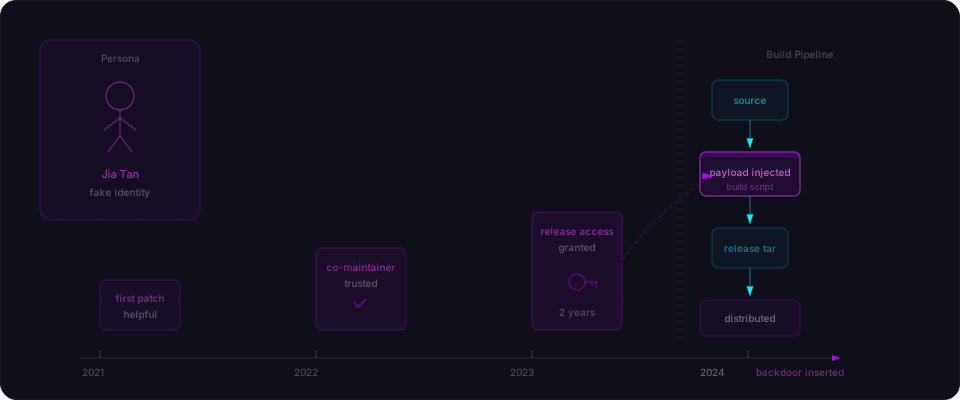
In February 2024, a new release of XZ Utils shipped. Inside it: the backdoor, disguised in a way that would fool almost every detection mechanism.
By March 29, 2024 — just 29 days later — Andres Freund's laptop slowdown had unraveled the entire operation.
Three years to earn trust in open source. Twenty-nine days from activation to exposure. The attacker came within weeks of success.
How to hide a backdoor in plain sight
The backdoor in XZ Utils versions 5.6.0 and 5.6.1 (CVE-2024-3094, CVSS 10.0) was a masterclass in obscurity. It wasn't a suspicious line of code in the main library. It was hidden where nobody looks.
The payload was packed into test files. Binary test data, in tests/files/bad-3-corrupt_lzma2.xz and tests/files/good-large_compressed.lzma — files that exist in every project but almost nobody audits. Diffs skip binaries. Security reviews ignore test artifacts. Nobody was looking there.
The extraction happened during the build. When a Linux distribution compiled XZ Utils into a .deb or .rpm package, a hidden script extracted the payload. But with surgical precision: the script only activated if three conditions were all true:
- Building a
.debor.rpmpackage (not a raw source build) - On x86-64 architecture (not ARM, not other platforms)
- With the GCC compiler (not Clang or others)
Miss one condition? The build stayed clean. This meant:
- Source code audits saw nothing. The
.cfiles were innocent. - Developers building from source: no payload. If you compiled it yourself for your own system, you were fine.
- Pre-built packages: all compromised. But the packages shipped in distributions? Every single one carried the backdoor.
Once compiled into the compression library (liblzma.so), the code used standard library hooks to intercept SSH authentication. When SSH loaded the compromised library to check credentials, the backdoor silently watched for a specific signature. If it arrived, the attacker got shell access as root — no password, no username, no trace.
All without a single line of suspicious code visible in a source review.
How it was found
Andres Freund was not doing a security audit. He was not running a supply chain monitoring tool. He was benchmarking SSH performance on a personal system running Debian Sid — the bleeding-edge, unstable branch that early adopters use for testing.
He noticed two things: SSH logins were consuming about 500ms more CPU than expected, and Valgrind (a memory analysis tool) was throwing errors related to liblzma. That combination was odd. SSH doesn't normally use liblzma for anything performance-critical.
Freund followed the thread. He traced the CPU spike to the library, examined recent changes in XZ Utils, and found obfuscated code in the build scripts. He then reverse-engineered the backdoor — a significant technical undertaking — to understand what it actually did.
On March 29, 2024, he posted his findings to the oss-security mailing list. Within hours, major Linux distributions were rolling back to safe versions of XZ Utils.
The distributions that had already shipped the backdoored version — Fedora 40 and 41 beta, Debian Sid and Testing, openSUSE Tumbleweed, Kali Linux, Arch Linux, and briefly Ubuntu 24.04 — were all rolling releases or pre-release builds. Stable, production-oriented releases like Debian Stable, Ubuntu LTS, RHEL, and Amazon Linux never shipped the backdoored packages.
The operation failed because of a performance anomaly on one engineer's laptop. That's how close it came.
Your app depends on hundreds of Jia Tans you've never met
Here's the uncomfortable truth: the XZ Utils story is not history. It's a template you're exposed to right now.
When you build with Cursor, Lovable, v0, or Replit, your app ships on Linux. The servers, the containers, the deployment pipelines — all Linux. The AI tools themselves run on Linux. You're many layers removed from the OS, but not independent from it.
More directly: your app depends on packages. Dozens directly, hundreds if you count the full dependency tree. You have read almost none of that code. You couldn't list all of it from memory.
This is where AI-generated apps hit a specific vulnerability.
When Claude or Cursor generates your requirements.txt or package.json, it's drawing on training data. That data reflects what was trusted and common — at training time. The AI tool has no way to know that a package got compromised after its training cutoff, or that a maintainer who looked reliable for three years just proved they were actually an attacker.
The XZ Utils operation proved something important: a trust-based attack cannot be caught by auditing code or commit history. The contribution history was real. The code quality was real. The reputation was earned over 24 months of genuine work. Any automated tool scanning commits would see exactly what it should see: a reliable contributor doing solid work.
And then, one day, with full commit access, that contributor published a backdoor.
If you're running any app that depends on XZ Utils — which includes basically every Linux server — you depended on that attacker's reputation without knowing it. You still do, for every other package in your tree.
Did your systems run the backdoor?
If you deployed on Linux around February–March 2024, verify your current state. Quick check.
The good news: most production systems were safe. The backdoor only reached rolling-release distributions — Debian Sid, openSUSE Tumbleweed, Arch, Kali. Stable, LTS releases like Debian Stable, Ubuntu LTS, and RHEL were never affected. The bad news: if you were using any bleeding-edge distro in early 2024, you might have had it.
Check your version:
xz --version
If it says 5.6.0 or 5.6.1, downgrade immediately:
# Debian/Ubuntu
apt install xz-utils=5.4.6-1

# Fedora
dnf downgrade xz-5.4.6
Then check your SSH logs for anomalies:
journalctl -u sshd | grep error
If you're on a stable, LTS, or long-term-support distribution (even if you weren't actively maintaining it), the chance you ran this is near zero. But checking takes 90 seconds.
What this means for your app (and why you depend on people like Jia Tan)
When you ship with Cursor, Lovable, v0, or Claude, your app doesn't exist in isolation. It runs on Linux. It depends on packages you've never read. Hundreds of them, if you count the full tree. You have no way to verify they're safe.
The XZ Utils attack reveals a brutal truth: trust-based attacks cannot be caught by scanning code or reading commit history.
Jia Tan's contributions were real. The reputation was earned. A three-year track record of solid work. Any automated security tool scanning commits would have seen exactly what it should see: a reliable contributor doing reliable work. Until the day they weren't.
This is not theoretical. If you're running any application that depends on XZ Utils (which includes basically every Linux server), you depended on Jia Tan's reputation without knowing it. So did thousands of others. The attacker came 29 days away from compromising all of it.
The XZ Utils operation proved something critical: you cannot audit your way out of supply chain trust. CVE databases are useless here. The backdoor wasn't a bug; it was deliberate code inserted with earned access. No vulnerability, no CVE, no database entry — until after the attack was live.
1. Pin your dependencies. Remove floating version ranges (^1.2.3, >=2.0). Use exact versions. When you upgrade, do it deliberately — manually, in a pull request, reviewed before merge.
{
  "dependencies": {
    "express": "4.18.2",      // Good: exact
    "axios": "^1.6.0"          // Bad: floats to latest
  }
}
2. Commit your lockfile. package-lock.json, yarn.lock, poetry.lock are security artifacts, not generated files. Commit them. In CI, run npm ci or yarn install --frozen-lockfile, never npm install. Every dependency change should be reviewable.
3. Audit your dependency tree once. Not obsessively. Just once. Run npm ls and look at the first two levels. Know what you depend on and what those packages depend on. You don't need to understand all the code, but you should at least know the shape of the tree.
npm ls # See your full dependency tree
npm ls --depth=2 # First two levels only
4. Watch for anomalies. Andres Freund caught XZ because SSH was slow. That's luck, not a security process. But luck is better than nothing. Performance regressions, resource spikes, unexpected errors — these are signals that something changed at a layer below your code.
5. Use stable releases in production. The XZ Utils backdoor hit rolling-release distros with rapid release cycles. Stable and LTS releases move slower, which means slower uptake of malicious versions. That friction is worth it.
What to do before your next deploy
Jia Tan was caught by accident. An engineer's laptop was slow. You should not ship betting on luck.
-
Pin your dependencies. Exact versions in
package.jsonorrequirements.txt. Remove^,~, and ranges. Every upgrade should be manual and reviewable. -
Commit your lockfile.
package-lock.json,yarn.lock,poetry.lock— these go in version control. In CI, usenpm cior equivalent. Every install should produce identical results. -
Audit your dependency tree once. Run
npm ls --depth=2and look at what you depend on. You don't need to understand the code, but you should know what's in your tree. -
Watch for anomalies. Performance regressions. Unexpected errors. Resource spikes. These are signals that something changed below your code.
-
Use stable releases in production. Rolling-release distros move fast. LTS and stable releases move slow. The friction is a feature.
The XZ Utils backdoor ships in every vibe-coded app built on Linux (which is all of them). CVE databases can't catch maintainers who turned malicious with earned access. But knowing your tree — even roughly — gives you a fighting chance. You're not looking for perfection. You're looking for visibility.
Scan your own app with Flowpatrol before you ship. Get a baseline on what's exposed: endpoints returning data without auth, leaked secrets, broken access controls. That's the layer you can actually control. The Linux layers? You're dependent on the community. But you can at least know what you're depending on.
The XZ Utils backdoor (CVE-2024-3094) was discovered and publicly disclosed by Andres Freund on March 29, 2024. Technical analysis available from JFrog Security Research, Datadog Security Labs, and Akamai. CISA advisory: March 29, 2024.