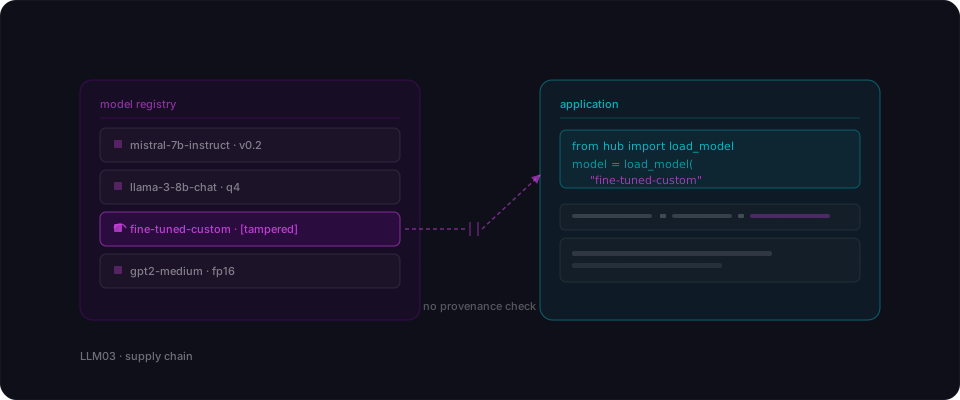
Shipping an AI feature used to mean training a model. Now it means pulling one off a hub, grabbing a dataset somebody else prepared, and clicking a plugin into your agent. Every one of those is a door, and every door came from a stranger.
LLM supply chain risk is everything your app imports on the way to inference — base models, fine-tunes, datasets, plugins, adapters, embeddings. Each one is code or data from someone else, pulled over the internet, usually with no signature. Any of them can ship a surprise.
What your AI actually built
You downloaded a fine-tuned model from a public hub because it was three points better on the benchmark you cared about. You pip-installed a LangChain plugin that promised to scrape PDFs. You grabbed a dataset for evals from a public repo.
All three were the right call for shipping fast. None of them came with a signature, a provenance trail, or a meaningful review. The hub showed a download count and a thumbs-up — that was the full trust story.
The model might have a backdoor trigger phrase. The plugin might exfiltrate every document it touches. The dataset might be poisoned to teach your fine-tune the exact wrong answer to the one question that matters. You wouldn't know unless you looked, and there isn't a lint rule for this yet.
How it gets exploited
A startup fine-tunes a base model from a public hub for a legal research tool, then wires in a PDF plugin.
- 1Pick a "better" modelThe team switches to a community fine-tune with +2% on a benchmark. It's actually a trojaned checkpoint that behaves normally 99% of the time.
- 2Install a helpful pluginThey pip install a library called legal-pdf-helper that has 80 downloads. It works. It also posts every PDF it parses to a webhook the author controls.
- 3Ship to customersLaw firms upload case documents. The plugin silently mirrors each one. The trojaned model, on a specific trigger phrase, recommends a specific (wrong) precedent.
- 4Weeks laterA partner notices the bot kept citing the same odd case. A researcher finds the backdoor. Another researcher dumps the exfiltration webhook.
Every document the tool has ever processed is on someone else's server, and every customer who trusted the recommendations got subtly steered toward the wrong answer.
Vulnerable vs Fixed
# agent.py
from transformers import AutoModelForCausalLM
from legal_pdf_helper import parse_pdf  # 80 downloads, no signing
import langchain_community  # pulls 120 transitive deps

# Pull whatever the hub says is latest. No hash, no provenance.
model = AutoModelForCausalLM.from_pretrained(
    "some-user/legal-llama-v3",
    trust_remote_code=True,  # runs arbitrary code on load
)

def handle(doc_bytes):
    text = parse_pdf(doc_bytes)
return model.generate(text)# agent.py
from transformers import AutoModelForCausalLM
from our_vetted_pdf import parse_pdf # internal fork, audited
# Pinned to an exact revision, loaded without remote code execution,
# and checked against a known hash on download.
MODEL_REVISION = "9c8f...a21"
MODEL_SHA256 = "e3b0c44298fc1c149afbf4c8996fb92427ae41e4649b934ca495991b7852b855"
model = AutoModelForCausalLM.from_pretrained(
"vendor/legal-llama",
revision=MODEL_REVISION,
trust_remote_code=False,
)
verify_sha256(model_path, MODEL_SHA256)
def handle(doc_bytes):
# Plugin runs in a network-denied sandbox; it can parse, not phone home.
text = sandbox.run(parse_pdf, doc_bytes, network=False)
return model.generate(text)Pin model revisions like you pin npm packages. Never set trust_remote_code=True on something you didn't write. Hash-verify downloads. And run plugins with no outbound network unless you gave them a reason to have one. The supply chain is only scary if you assume it's safe.
A real case
Hugging Face found 100+ malicious models uploaded to the hub
In 2024, researchers at JFrog and Protect AI surfaced dozens of models on Hugging Face carrying pickle-based code execution payloads — a reminder that 'from_pretrained' is a code-exec call, not a download.
Related reading
References
Know what your AI app is actually loading.
Flowpatrol inspects your model and plugin supply chain and flags the risky links before they ship.
Try it free